Lot #167

František Muzika (1900–1974)
Landscape
Estimate: 10,000,000 CZK – 15,000,000 CZK
8,000,000 CZK


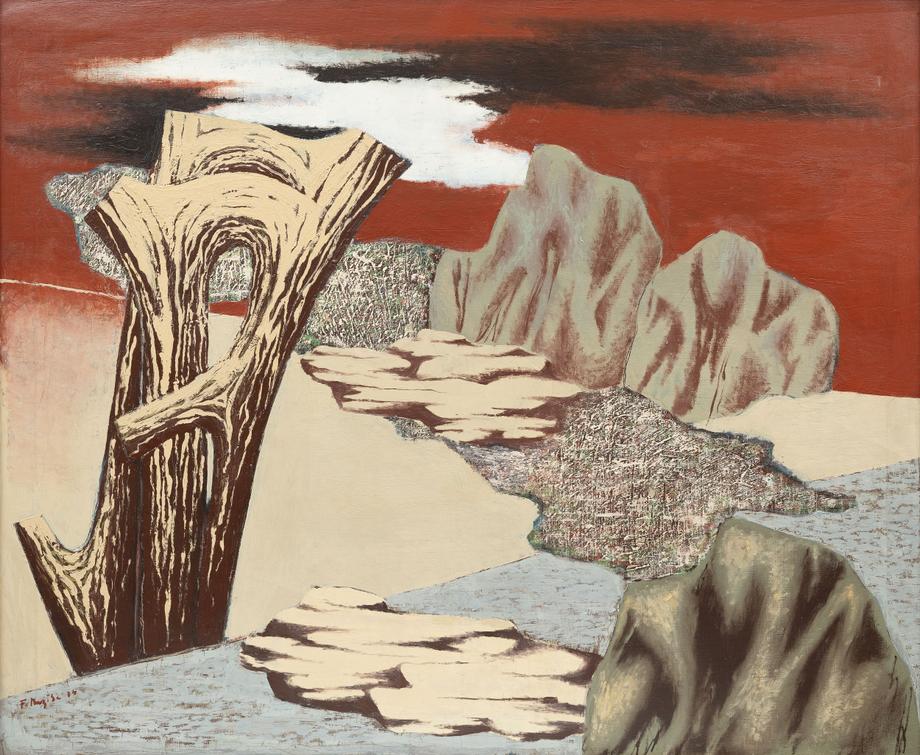
The painting was created in 1934, at a time when František Muzika was moving away from Cubist composition towards imaginative painting. A decisive stimulus was the Prague exhibition Poesie 1932, which brought the fragmented Devětsil generation together once more and, for the first time since pre-war Cubism, presented Czech art alongside that of Hans Arp, Salvador Dalí and Max Ernst, artists already recognised at a European level. Muzika gravitated towards a freer current within this movement, unlike Toyen and Jindřich Štyrský, whose artistic outlook he had opposed since the late 1920s and who later became members of the Group of Surrealists in Czechoslovakia. At the same time, the Aventinum-published journal Musaion, which Muzika edited with Otakar Štorch-Marien, devoted sustained attention to Surrealist painting. Visual motifs thus entered Muzika’s canvases as he was simultaneously exploring them in his work as an editor and critic.
Despite the considerable freedom of form, the scene remains legible, and it is precisely this restraint that distinguishes Muzika’s imaginative painting. These are neither dream visions nor arbitrary collisions of objects, but a recurring repertoire of deliberately ambiguous forms poised between the organic and the mineral. They appear suspended in a state of transformation, suggesting an ancient, inexhaustible force. The twisted trunk and fragments of rock belong to this group of archetypal motifs. They recur throughout Muzika’s paintings from the late 1920s onwards, each time emerging in a different configuration.
A rust-red sky, torn by a white cloud, presses against a cool blue-grey expanse, where pale forms accumulate like layers of peeling sediment. The irregularly scattered, roughened patches of earth are conceived as independent structural fields – the same element in which Muzika’s biographer František Šmejkal already discerned, in canvases dating from 1933, a sign of an impending transformation in the artist’s outlook. Here, these textured areas serve as a tactile counterpoint to the smoothly rendered colours.
The thin, dark grooves in the rocks evoke the folds of drapery in torsos transformed into landscapes, a motif Muzika had explored since the 1920s. Fabric becomes stone, while the modelling of the rocky masses follows the same principles as the modelling of the human body. The stage-like arrangement of planes receding one behind another finds a direct parallel in the theatrical work Muzika undertook for Jindřich Honzl from 1929 onwards. According to Šmejkal, it was into this work that Muzika also transferred “the angular walls from his most recent landscapes”.
A direct counterpart to the present painting is held in the collection of the National Gallery Prague (Landscape, oil on canvas, 1935, 80 × 120 cm). The present work was acquired by its current owner directly from the artist’s studio in the 1930s. It was assessed during consultations with Prof. J. Zemina and PhDr. R. Michalová, Ph.D. An expert opinion by PhDr. K. Srp is attached.
Other lots in the same auction:
 Cookies settings
We use cookies to improve your user experience and our services. You can give your consent by clicking on the button "Allow all".
More information about data protection and cookies.