Lot #162
Václav Brožík (1851–1901)
Two Artists
Estimate: 2,500,000 CZK – 3,500,000 CZK
1,800,000 CZK


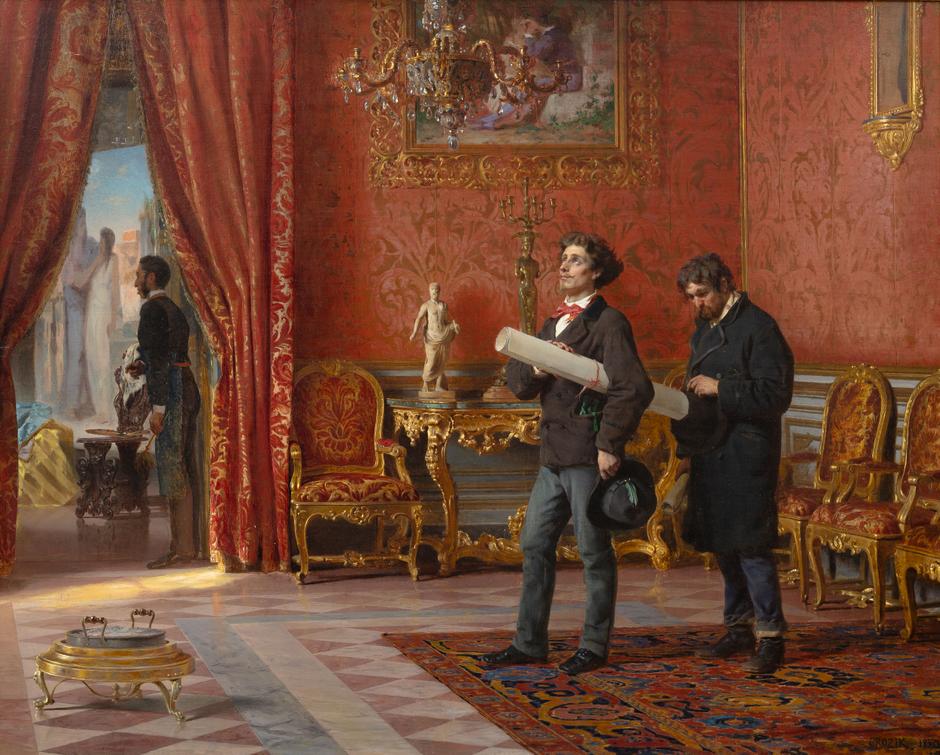
Set in a lavishly furnished upper-class drawing room, this remarkable scene from the everyday life of an artist of the period is a subject rarely encountered in fine art. The painting is an exceptional work from the mature period of Václav Brožík’s career, when he was one of the leading members of the so-called National Theatre Generation and a professor at the Academy of Fine Arts in Prague. This unique, museum-quality canvas confirms his pre-eminent position among Czech history painters of the second half of the 19th century, while also demonstrating his profound knowledge of European painting, particularly the French and Dutch traditions.
The central figures are two artists awaiting an audience with a prospective patron of their paintings, which they have brought along, rolled up and ready to present. They can be positively identified as close friends and colleagues: Vojtěch Hynais and the painter of the present work, Václav Brožík. With a well-judged touch of humour and consummate artistic skill, Brožík portrays both men with remarkable precision, capturing their posture as well as their attire. A contrast emerges between the self-assured bearing of Hynais, dressed as a fashionable man of the world, and Brožík, who stands modestly in worn shoes and with his trouser legs carelessly rolled up. The characterisation of the third figure, a servant announcing the two visitors to his master, is equally precise and seemingly caricatural, revealing his haughty arrogance. In the antechamber where the two painters await their audience, Brožík depicted a wealth of luxurious art objects in meticulous detail, including a Persian carpet, a foot warmer, furniture, curtains and wallpaper. Their exquisite rendering, almost convincing to the touch, was one of his specialities. The painting also contains a virtuoso artistic jeu d’esprit: a picture within a picture, which most likely depicts a pair of lovers in a secluded garden setting.
The dating of the painting is also significant. By the time it was created, Brožík had been married for a year to Hermína Sedelmeyerová, the daughter of a wealthy art dealer who was also his agent, introduced him to high society and secured a steady flow of commissions. The painting can therefore be seen as a somewhat self-ironic reminiscence of Brožík’s younger years, when, with his naturally modest disposition, he would wait to discover whether his work would be accepted. The painting has been repeatedly published and reproduced in specialist literature (M. Mžyková: Křídla slávy, Vojtěch Hynais, čeští Pařížané a Francie, Vol. I, Prague, 2000, p. 150; N. Blažíčková-Horová: Václav Brožík, 1851–1901, Prague, 2003, p. 235, cat. No. 69).
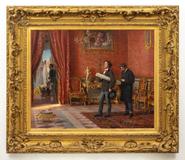
In view of the above, the painting can undoubtedly be regarded as an exceptional collecting opportunity, possessing outstanding artistic and aesthetic merit. It is presented in a tasteful period frame. It was assessed during consultations with Prof. R. Prahl, CSc, and Mgr. M. Dospěl, Ph.D. An expert opinion by PhDr. Š. Leubnerová is attached.
Other lots in the same auction:
 Cookies settings
We use cookies to improve your user experience and our services. You can give your consent by clicking on the button "Allow all".
More information about data protection and cookies.