Lot #137
Josef Šíma (1891–1971)
Orpheus
Estimate: 6,000,000 CZK – 8,000,000 CZK
4,800,000 CZK


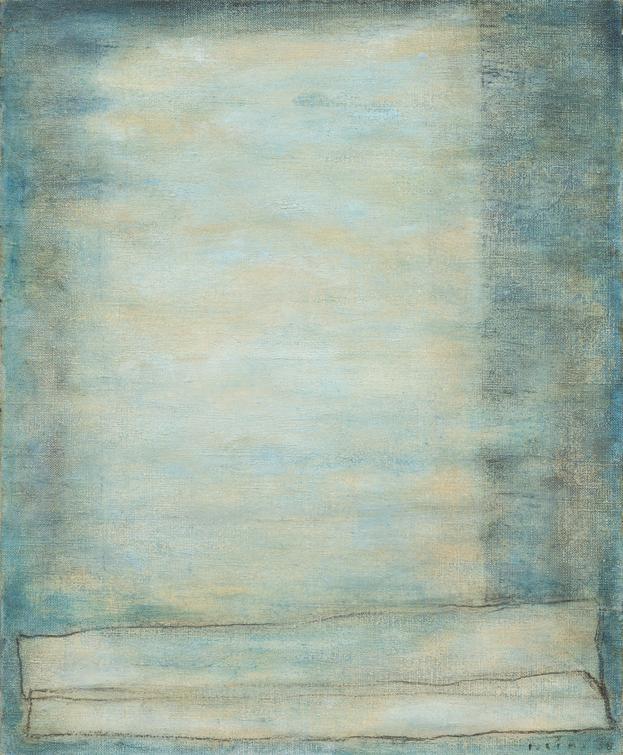
In Orpheus, Josef Šíma was captivated by the timeless resonance of ancient mythology. The painting belongs to the series of Orpheus’s gates, which he developed primarily in 1957–1958, stripping the ancient myth of its figurative narrative in favour of the motif of the gate itself and the passage between worlds. Rather than depicting the mythical poet, a subject explored by many artists, Šíma reduced the myth to its ultimate spatial situation: a threshold between two realms of being, between the material and the immaterial, darkness and light, beginning and dissolution. The gate thus becomes the threshold of existence itself.
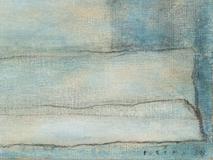
Almost the entire canvas is occupied by a luminous field, its translucent blue-grey layers interpenetrating and dissolving into a darker, indeterminate space. In the lower section, this ethereal formation is grounded by horizontal bands that evoke the earth, or at least a general idea of it. Beyond them, perspective ceases to apply, and space is created by light alone. The Gate of Orpheus is not an architectural structure; it emerges from the relationship between light and matter itself, from the gradual dissolution of solid forms and the boundaries separating physical space from that which is only intuited.
In 1958, Šíma articulated his artistic approach in a letter to his friend Josef V. Brumlík, explicitly rejecting the description of his painting as abstract and naming it matière lumière, or ‘matter–light’, or simply ‘Orpheus’. For him, light was not merely a formal property of colour but a substance in its own right, permeating matter and transforming it. In this respect, his concept of matière lumière differed from the lyrical abstraction and Art Informel of the period. While luminosity, translucency and gesture could function as autonomous painterly devices in those movements, Šíma subordinated them to a poetic and philosophical understanding of the world, rooted in the intellectual circles with which he had been associated before the Second World War. Orpheus thus demonstrates how, in the late 1950s, Šíma translated his pre-war visual imagination into a language freed from fixed forms without abandoning its underlying intellectual foundations.
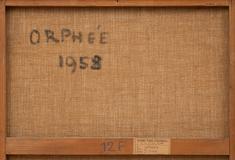
The work originally belonged to the collection of Galerie Paul Facchetti, which represented Šíma in 1959–1960. It was assessed during consultations with Prof. J. Zemina and Mgr. Ch. Zimová of the Josef Šíma Foundation. An expert opinion by PhDr. K. Srp is attached.
Other lots in the same auction:
 Cookies settings
We use cookies to improve your user experience and our services. You can give your consent by clicking on the button "Allow all".
More information about data protection and cookies.