Lot #122
Josef Čapek (1887–1945)
Saturday
Estimate: 6,000,000 CZK – 12,000,000 CZK
4,000,000 CZK


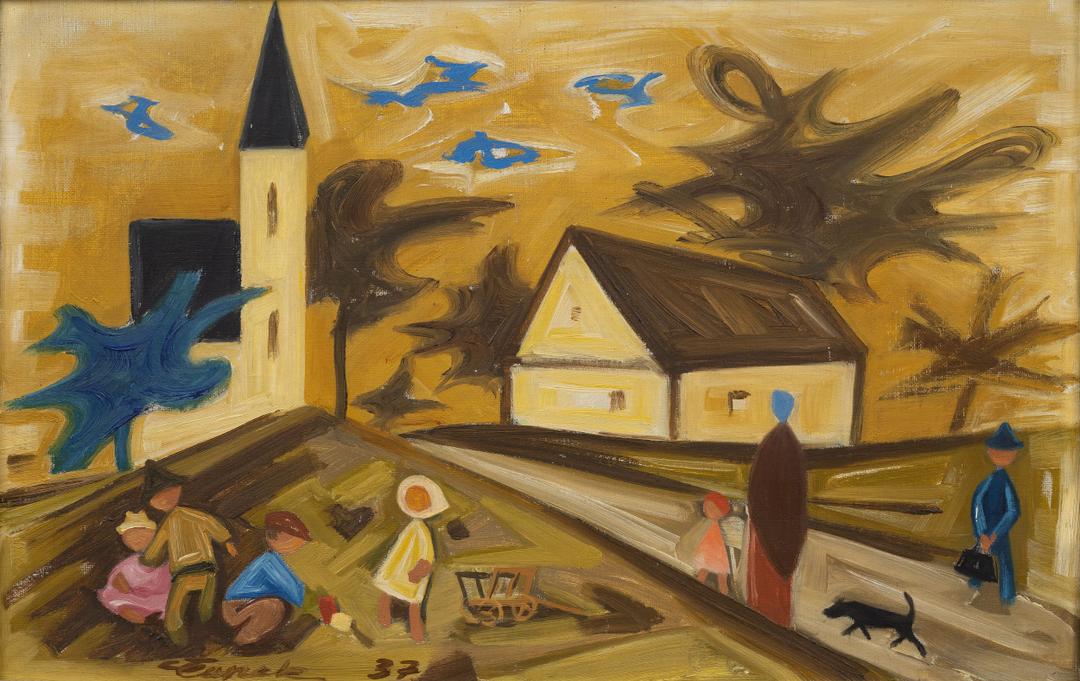
Saturday belongs to a remarkable group of paintings by Josef Čapek inspired by the Orava region, which the artist and his family visited regularly from 1930 onwards. It was here that he found seemingly unremarkable subjects – country people on the road, women with children, agricultural work and fleeting encounters on the outskirts of a village – which, in his interpretation, acquired a more universal and almost timeless significance. These paintings also reflect the ideas explored in his philosophical essay Kulhavý poutník (Limping Pilgrim, 1936): an interest in the ordinary moment, which, despite its apparent insignificance, may embody a deeper dimension of human existence.
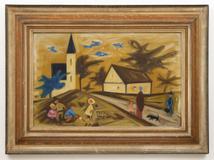
The presented canvas likewise stems from an everyday rural scene, which Čapek transformed into an exceptionally lively pictorial composition. He structured the scene around several diagonals formed by paths and field boundaries, among which small figures of adults and children appear, together with a child’s cart and the black silhouette of a dog. A small church with a tall tower rises in the background, while a village dwelling and tree crowns, with birds in the sky, introduce rhythm and movement. A free, energetic brushwork is combined with a vivid palette of ochres, browns, yellows and blues. Čapek simplified the individual figures almost to the point of symbols, yet the scene retained the immediacy of lived reality. The ability to elevate an ordinary moment of life into an image of more universal human interaction is one of the defining qualities of this mature phase of the artist’s work.
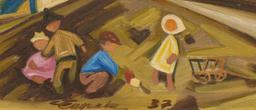
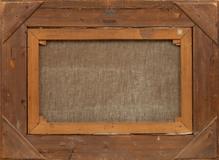
The painting’s exceptional significance is further enhanced by its provenance. Its original owner was the industrialist Václav Palivec, brother-in-law of Čapek’s sister Helena, who acquired several of the artist’s paintings during the 1930s and, after the Second World War, donated part of his collection to Olga Scheinpflugová. From 1968, the work was owned by JUDr. Karel Scheinpflug Sr. This history is eloquently documented by the inscription on the reverse of the painting: ‘Josef Čapek (p. rada Palivec) Sobota 1937’. The stretcher also bears a label from the 1938 members’ exhibition of the Umělecká beseda association in Prague, part of a paper label used by JUDr. Scheinpflug, and the inscription ‘dr. Scheinpflug’.
The painting is recorded as No. 318 in Jaroslav Slavík’s working database and in Pavla Pečinková’s current catalogue raisonné (Pracoval jsem mnoho, Soupis výtvarného díla Josefa Čapka, vol. III: Malba, Humpolec, 2023, cat. No. III/482), where it is also reproduced on p. 641. It was assessed during consultations with Prof. J. Zemina and PhDr. R. Michalová, Ph.D. An expert opinion by PhDr. P. Pečinková, CSc, is attached.
Exhibited:
· Členská výstava Umělecké besedy, Municipal House, Prague, 5–28 February 1938, cat. No. 51
· Josef Čapek (1887–1945): Obrazy a kresby, National Gallery in Prague, Prague Castle Riding School, 3 May – 8 July 1979, cat. No. 180 (subsequently at the Regional Gallery in Hradec Králové, 19 July – 25 August 1979; Brno House of Arts, 2 September – 14 October 1979; Regional Gallery in Liberec, 10 January – 24 February 1980)
· Josef Čapek a děti, North Bohemian Gallery of Fine Arts in Litoměřice, 1 September – 23 October 1988, cat. No. 155 in the supplement to the selection of oil paintings (subsequently at the Karlovy Vary Art Gallery, 24 November – 23 December 1988; Music Theatre, Prague, 4 January – 4 February 1989)
Other lots in the same auction:
 Cookies settings
We use cookies to improve your user experience and our services. You can give your consent by clicking on the button "Allow all".
More information about data protection and cookies.