Lot #92
Jan Zrzavý (1890–1977)
Small Pond
Estimate: 1,500,000 CZK – 2,500,000 CZK
Starting price: 1,200,000 CZK
1,200,000 CZK


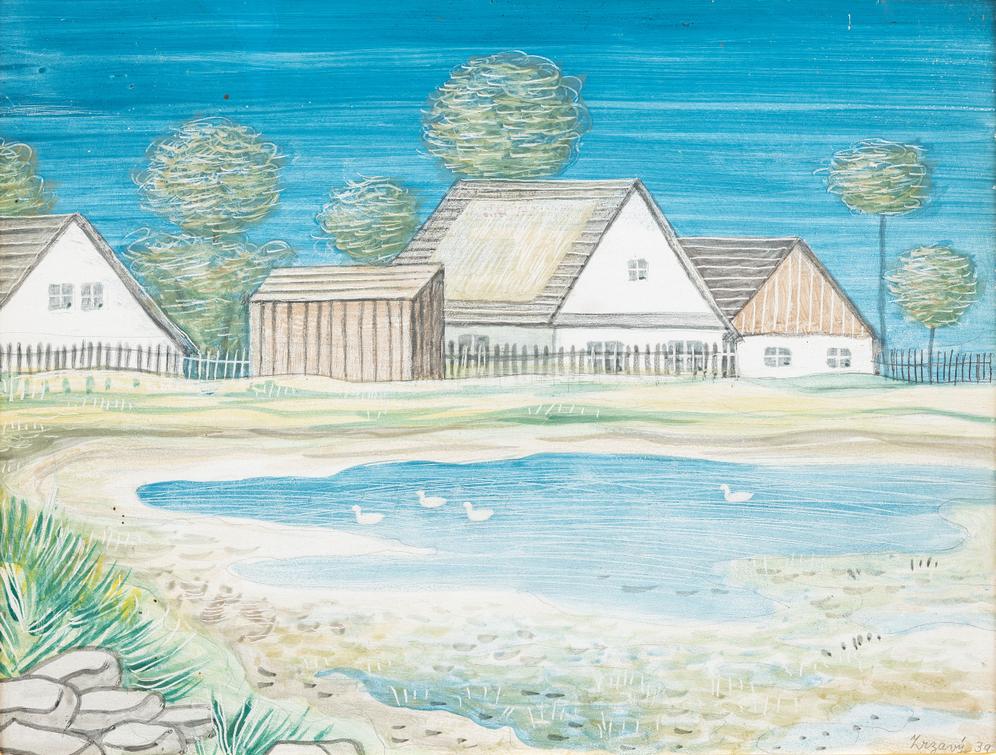
The charming Small Pond is a striking testament to the transformation of Jan Zrzavý’s landscape painting at the turn of the 1940s. The tranquil rural subject is stripped of incidental details and reimagined within a distinctive, almost dreamlike pictorial order. The foreground is occupied by the irregular blue surface of a pond, with ducks floating on it as small, bright accents. Beyond it, rural houses with steep roofs, wooden fences and stylised tree crowns form a rhythmic sequence, beneath a broad expanse of blue sky. Zrzavý substantially simplified the observed world. He reduced the houses to pure geometric forms and constructed the space not through rigorous perspective, but by arranging several horizontal planes. Drawing plays a prominent role, clearly defining the individual motifs and lending the entire composition a distinct rhythm.
The work dates from a particularly turbulent period in the artist’s life. Following the outbreak of the Second World War, he turned more intensively towards the Czech countryside, particularly the Vysočina region and places associated with his childhood. Nevertheless, Small Pond does not represent a radical departure from his earlier work in Brittany; rather, the artist transferred his French experience to the Czech landscape. In this sense, the pond itself may be understood as an intimate, inland counterpart to the sea, which had occupied an important place in his Breton compositions. Within Zrzavý’s oeuvre, Small Pond thus captures a moment when the Czech countryside became a vehicle for the same kind of poetry that the painter had previously found along the Atlantic coast. Through the reduction of forms, rhythmic arrangement and gently naïve stylisation, this simple scene acquires a timeless quality.
The work was assessed during consultations with Prof. J. Zemina and PhDr. R. Michalová, Ph.D. An expert opinion by PhDr. K. Srp is attached.
Other lots in the same auction:
 Cookies settings
We use cookies to improve your user experience and our services. You can give your consent by clicking on the button "Allow all".
More information about data protection and cookies.