Lot #87


Josef Šíma (1891–1971)
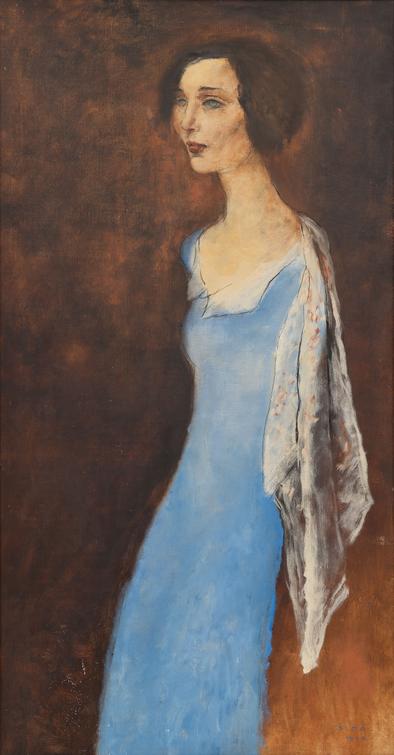
Portrait of Ljuba Veselá
Estimate: 13,000,000 CZK – 18,000,000 CZK
9,000,000 CZK


The painting belongs to the final phase of a coherent series of approximately thirty portraits in which, between 1928 and 1935, Šíma sought to capture those close to him in the unity of their outward appearance, inner presence and unique way of being. Initially, he portrayed his Parisian friends from the circle of the High Game (Le Grand Jeu); in the 1930s, he increasingly turned to Czech friends. He often began working on these paintings in Prague, as he did with the present work, completing them in Paris on the basis of sketches. For Šíma, portraiture ceased to be a commission or merely a formal artistic exercise and became a means of intimate understanding: an image intended more for contemplation of the individual than for their representation. In his painting, he returned to techniques rejected by the avant-garde – the modelling of light, flowing line and tonal gradation – in order to achieve the very opposite of conventional depiction. He freed most of his sitters from the specifics of their time, allowing them to emerge from an indistinct darkness. In the portrait of Ljuba Veselá, by contrast, he retained her light dress and draped shawl, whose cool blue is set against an earthy background. Yet the body approaches the condition of a torso: the hands disappear, the figure dissolves towards the bottom, and the full intensity of expression is concentrated in the elongated neck and delicately modelled face. Šíma understood the tilt of the head and the way the neck joined the body not as mere indications of physical appearance, but as signs of inner character. As Hana Volavková observed in 1936, he read them much as a palm-reader interprets the lines of the hand. In this portrait, however, the divinatory tension subsides, and the spectral quality familiar from his portraits of Daumal and Gilbert-Lecomte gives way to an exceptionally sensitive observation of an individual face. The closeness between the artist and his sitter was no passing episode. Surviving correspondence shows that Šíma maintained regular written, telephone and personal contact with Ljuba Veselá well into the 1960s. His relationship with her family had its roots in the interwar friendship between Šíma, Josef Veselý and Josef Brumlík, the trio nicknamed the ‘Trois Joseph’. The year 1933 also foreshadowed a fundamental shift in Šíma’s work towards myth, the symbolism of the fall and a premonition of catastrophe, as exemplified by works such as Sea and Return of Theseus. Still rooted in the idea of unity and a shared primordial foundation of consciousness, this portrait was thus created just before the advent of a world in which the individual portrait would lose its former place. After 1935, Šíma devoted himself to portraiture only exceptionally.
The work comes directly from the estate of Ljuba Veselá’s family. It was published and reproduced in the artist’s monograph (F. Šmejkal, Josef Šíma, Prague, 1988, p. 168, fig. 160) and shown at the artist’s solo exhibition at the Umělecká beseda (Josef Šíma 1926–1936, Prague Municipal House, 5 November – 6 December 1936, cat. No. 59). The work was assessed during consultations with Prof. J. Zemina and PhDr. K. Srp. An expert opinion by Mgr. Ch. Zimová of the Josef Šíma Foundation is attached.
Other lots in the same auction:
 Cookies settings
We use cookies to improve your user experience and our services. You can give your consent by clicking on the button "Allow all".
More information about data protection and cookies.