Lot #77

Toyen (1902–1980)
Finis Terrae
Estimate: 80,000,000 CZK – 120,000,000 CZK
60,000,000 CZK


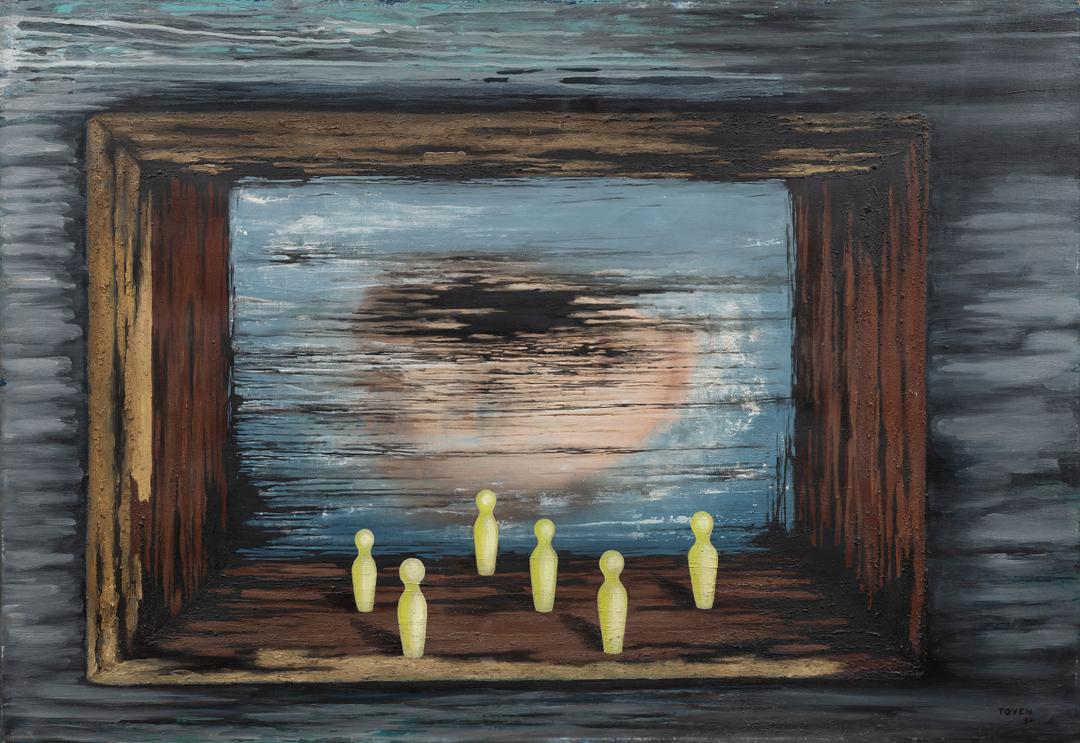
The rare canvas Finis terrae, painted in 1937 and held in a private collection for several decades, is one of Toyen’s outstanding works. A painting of major significance to public collections, and of exceptional artistic and collectible value, it was created at a time when the artist’s painterly language had reached full maturity and Prague Surrealism had become an integral part of the international movement. Together with Jindřich Štyrský, Toyen was instrumental in founding the Group of Surrealists in Czechoslovakia in 1934, and in the years that followed she established close personal and artistic ties with André Breton’s circle in Paris. These connections endured after the war and, in 1947, culminated in her permanent move to Paris, where she became an active member of the French Surrealist group. Her works featured in major international Surrealist exhibitions in London, Paris and other European centres. Toyen was thus not merely a representative of the Czech interwar avant-garde, but one of the most distinctive and prominent figures in Surrealism worldwide.
The second half of the 1930s was a period of exceptional concentration in her work. The earlier Artificialist landscapes gave way to disquietingly concrete objects placed in settings that defy the laws of reality. Familiar things became bearers of hidden meanings, while human presence was transformed into an apparition, a trace or a vision. As war approached, this tendency intensified, and the artist’s imagination took on an increasingly dark and anxious character. Finis Terrae is one of the most compelling examples of this creative shift. Here, Toyen brought together several motifs that had occupied her during the first half of the 1930s, combining them into a new and meticulously conceived whole.
A monumental crate opens up like a theatre stage or a passage into another reality. Several solitary skittles stand on its threshold, while the space beyond them merges into an endless expanse of water, in which an enormous human face appears. The boundaries between object, landscape and apparition dissolve, leaving the viewer uncertain as to what is real and what is merely a vision. It was precisely this paradox that also attracted the attention of Jan Mukařovský, who analysed Finis Terrae in his study of aesthetics as an example of a Surrealist painting that fundamentally disrupts the habitual relationships between objects and space. The expanse of water is simultaneously an infinite horizon and a mirror; the skittles are real objects, yet also participants in a strange, almost ritualistic scene.
The reflection of the face may faintly evoke the myth of Narcissus, but Toyen transforms the motif of self-contemplation into something far more unsettling. The human image does not settle on the surface of the water, but disintegrates and disappears. Looking into oneself here leads not to self-knowledge, but to the gradual disappearance of identity. In this respect, Finis Terrae is closely related to other major paintings from 1937, particularly Spící (Sleeping; oil on canvas, 1937, 81 × 100 cm, private collection) and Sen (Dream; oil on canvas, 1937, 81 × 100 cm, private collection). In all three works, Toyen explored the tension between tangible reality and vision, between what can be named and what resists rational interpretation. Her Surrealism was not simply an illustration of dreams. The painting’s power derived above all from the precision with which seemingly disparate elements were brought together to form a convincing yet impossible space. The ability to transform a concrete object into a vehicle for psychological tension, desire and hidden meanings is one of the most distinctive features of her work.
The work’s layers of meaning are further enriched by its enigmatic title. The Latin phrase ‘finis terrae’ (‘the end of the earth’) evokes the outermost boundary of the known world, while also referring to Brittany, whose rugged coastal landscape held a strong attraction for both Toyen and Jindřich Štyrský. The title may also be associated with Jean Epstein’s experimental film Finis Terrae (1929), shot on the Breton island of Ouessant. Another influence was the artist’s recollection of a visit to the grave of the writer François-René de Chateaubriand on the islet of Grand Bé near Saint-Malo. The French writer had chosen this site for his burial, facing the open sea and the distant horizon. The image of a solitary place at the very edge of the mainland, exposed to the sea and to infinite space, resonates remarkably with the atmosphere of the painting. ‘Finis terrae’ may therefore signify not only the literal ‘end of the earth’, but also an imagined boundary between the visible and the knowable, beyond which lies a realm of memory, dreams and nothingness.
The year 1937 also stands on the threshold of a dramatic turning point in European history. Toyen’s Surrealist imagination gradually darkened, and motifs of threat, emptiness and destruction began to permeate her paintings, acquiring an even greater urgency after the occupation of Czechoslovakia. Viewed in retrospect, Finis Terrae thus appears not only as an enigmatic psychological landscape, but also as a premonition of a world losing the certainties on which it had hitherto relied. The contrast between the almost innocent motif of children’s game and the empty, boundless space in which it is set is all the more striking. Finis Terrae is one of the key works of Toyen’s interwar period and, at the same time, a supreme expression of Czech Surrealism. Visual and conceptual opposites converge in a single scene, their tension generating the painting’s compelling force. It does not reveal itself at first glance; instead, it repeatedly draws the viewer into its illusory space, where reality becomes vision and every seemingly discovered meaning opens up another mystery.
The work was first exhibited in 1938 at the third exhibition of Štyrský and Toyen at Topič Salon, an event also referred to as the second exhibition of the Surrealist Group, and was subsequently exhibited and published on several occasions. It comes from the highly important Hradec Králové collection of Rudolf Hršel, who acquired the painting directly from the artist; it has remained in the family of its first owner ever since.
Hršel first saw the painting at the 1938 exhibition and wished to purchase it. Toyen, however, was not in the habit of selling works immediately after they had been exhibited, and she felt a particularly strong attachment to this painting. She valued it highly and was reluctant to part with it. Hršel therefore made the artist’s acquaintance and invited her to spend the summer holidays at his large house in Nový Hradec, where other artists and their families also gathered. Toyen spent the summer of 1943 there. During this visit, she made a drawing in the young daughter’s keepsake book as a personal memento of the summer they had spent together. It was ultimately the friendship that developed between them that enabled Rudolf Hršel to acquire the painting from the artist.
The work was assessed during consultations with Prof. J. Zemina and PhDr. R. Michalová, Ph.D. An expert opinion by PhDr. K. Srp is attached.
Reproduced in:
· A. Breton: Toyen, Paris, 1953, p. 48
· F. Šmejkal / V. Linhartová: Imaginativní malířství 1930–1950, Hluboká nad Vltavou, 1964, fig. 128
· R. Ivšić: Toyen, Paris, 1974, p. 11
· J. Claverie: Štyrský, Toyen, Heisler, Paris, 1982, p. 35
· R. Bischof: Toyen, Das malerische Werk, Frankfurt am Main, 1987, p. 100, fig. 41
· Český surrealismus 1929–1953, Ateliér, 10 October 1996, No. 21, p. 4
· L. Bydžovská / K. Srp: Český surrealismus 1929–1953, Prague, 1997, p. 161
· K. Srp: Toyen, Prague, 2000, p. 136, fig. 164
· K. Srp: Toyen, une femme surréaliste, Saint-Étienne, 2002, p. 126, fig. 74
· A. Pravdová / A. Le Brun / A. Görgen-Lammers (eds): Toyen: Snící rebelka, Prague, 2021, p. 140, fig. 251
· A. Pravdová / A. Le Brun / A. Görgen-Lammers (eds): Toyen, L’écart absolu, Paris, 2022, p. 143, fig. 252
Exhibited:
· Štyrský a Toyen, 3rd exhibition, Topič Salon, Prague, January–February 1938, cat. No. 46
· Štyrský a Toyen, Umělecký kabinet, Bratislava, March 1938
· Štyrský a Toyen, Brno, April 1938
· Imaginativní malířství 1930–1950, Aleš South Bohemian Gallery, Hluboká nad Vltavou, 1964, cat. No. 128
· Štyrský a Toyen, Moravian Gallery in Brno, November–December 1966, cat. No. 185
· Štyrský a Toyen, SVU Mánes, Prague, January 1967, cat. No. 185
· Český surrealismus 1929–1953, Prague City Gallery, Municipal Library, 16 October 1996 – 5 January 1997, cat. No. 502
· Toyen, Prague City Gallery, the Stone Bell House, 12 May – 6 August 2000, cat. No. 77
· Toyen, Musée d’art moderne, Saint-Étienne, 28 June – 30 September 2002, cat. No. 74
· Toyen: Snící rebelka, National Gallery Prague, Waldstein Riding School, 9 April – 22 August 2021
· Toyen, Hamburger Kunsthalle, Hamburg, 24 September 2021 – 13 February 2022
Toyen, L’écart absolu, Musée d’art moderne de Paris, Paris, 25 March – 24 July 2022
Other lots in the same auction:
 Cookies settings
We use cookies to improve your user experience and our services. You can give your consent by clicking on the button "Allow all".
More information about data protection and cookies.