Lot #72


Ivan Konstantinovič Ajvazovskij (1817 – 1900)
Moonlit Night
Estimate: 2,000,000 CZK – 4,000,000 CZK
Starting price: 1,300,000 CZK
1,300,000 CZK


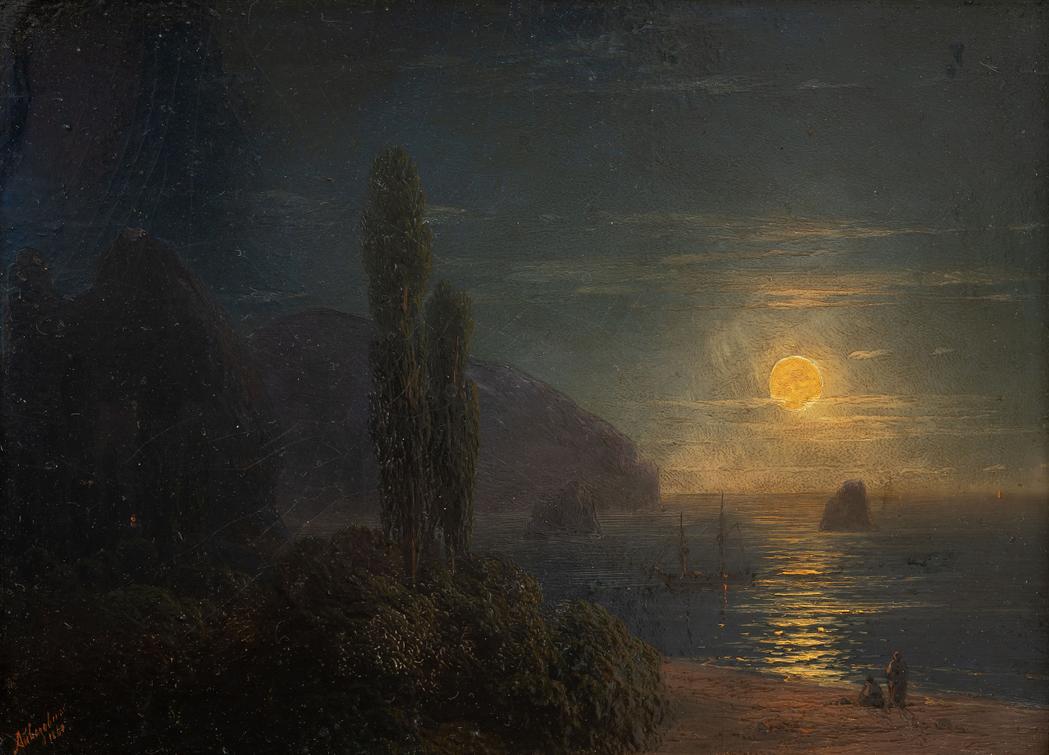
This exceptional painting, distinguished by its unique provenance, captures an alluring nocturnal seascape in a small, intimate format. On the Czech art market, it can unequivocally be regarded as an unprecedented opportunity to encounter the work of Ivan Konstantinovich Aivazovsky, one of the foremost representatives of European academic Romanticism, renowned for his landscapes, seascapes, battle scenes, biblical subjects and portraits. His professional life was closely associated with the Imperial Academy of Arts in St Petersburg, from which he graduated with distinction and where he later served as a professor. He soon became a prominent artist moving in the highest social circles, with direct connections to members of the imperial family. He travelled extensively and earned artistic and social acclaim beyond his homeland, in most of the major cultural centres of contemporary Europe. Today, the extraordinary scale of his artistic legacy is perhaps best represented by the collections of his native city of Feodosia, which holds more than four hundred of his works.
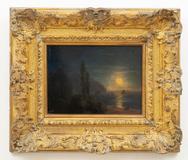
The painting depicts the southern coast of Crimea, with the full moon illuminating the calm surface of the sea, where a sailing vessel rocks gently at the heart of the composition. In the foreground, poplars rise towards the sky, while in the distance the outlines of the Crimean Mountains emerge, including the silhouette of Ayu-Dag (Bear Mountain), whose majesty is further emphasised by the small figures in the foreground. The painterly treatment of the picture surface is a textbook example of the artist’s mature style, characterised by a sophisticated, multi-layered glazing technique that enabled him to achieve soft, seamless tonal transitions. A detailed analysis of the signature, to which the artist also added the precise date, provides indisputable evidence of its authenticity.
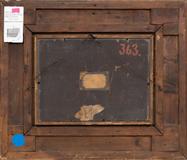
The reverse of the painting is equally important, bearing incontrovertible evidence of the work’s authenticity and unique provenance. The quality and date of the support board are entirely consistent with the materials Aivazovsky commonly used. The labels on the reverse document the provenance described above and confirm that the painting was recorded in the imperial collection. Their presence establishes that the work officially belonged to the art collection of Livadia Palace in Crimea, which served as the Romanov family’s southern residence. It was most likely displayed in the private apartments of Empress Maria Alexandrovna, wife of Tsar Alexander II, whose interiors were adorned with precisely this type of small, poetic seascape by Aivazovsky, arranged in numerous decorative groupings on the walls. In light of the evidence outlined above, the painting can be considered a work of the highest historical, cultural, collecting and institutional significance.
The work was assessed during consultations with Prof. R. Prahl and PhDr. Š. Leubnerová. An expert opinion by PhDr. J. Jančárková, PhD, is attached.
Other lots in the same auction:
 Cookies settings
We use cookies to improve your user experience and our services. You can give your consent by clicking on the button "Allow all".
More information about data protection and cookies.