Lot #57
Óscar Domínguez (1906–1957)
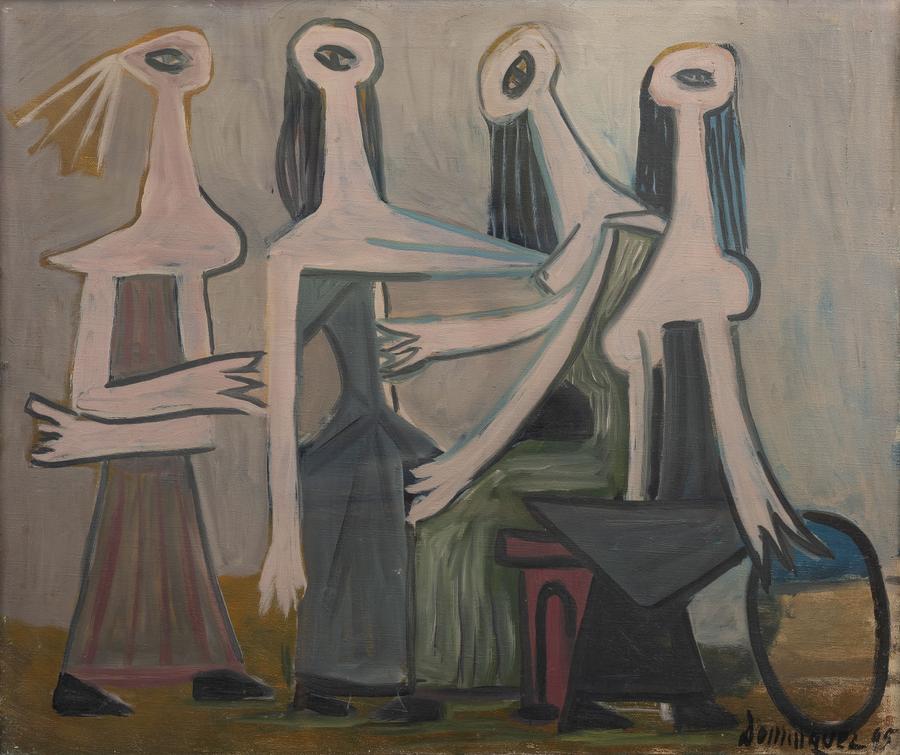
Women
Estimate: 1,500,000 CZK – 2,500,000 CZK
Starting price: 1,000,000 CZK
1,400,000 CZK


The end of the war found Óscar Domínguez in the midst of a quiet transformation. Following his break with Breton’s faction of Surrealism in 1939 and a metaphysical phase influenced by Giorgio de Chirico, he was searching for a compositional approach that would preserve the dreamlike imagery of Surrealism while drawing on a more solid structure derived from the work of Pablo Picasso and Wifredo Lam. The four stylised female figures, with their elongated bodies and single-eyed faces, are linked by the rhythm of their gestures and the contact between their arms. Their appearance evokes archaic depictions of the mother goddess and also recalls Wifredo Lam’s work of the period. The oval mirror held by the figure at the edge of the composition is a characteristic motif of Domínguez’s surrealist world, in which everyday objects acquire new, symbolic meanings. Like the alarm clock, butterfly and revolver, it becomes a means of transformation and of connecting reality with the world of imagination. Its significance may also be associated with Pierre Mabille’s book Le miroir du merveilleux (1940). The single-eye motif, too, goes beyond mere artistic stylisation and relates to the Surrealists’ interest in inner vision. It also acquired a particularly personal significance in Domínguez’s circle when, on 28 August 1938, the painter Victor Brauner lost his left eye during a scuffle between Domínguez and Esteban Francés. The Surrealists saw this incident as the fulfilment of a premonition captured in Brauner’s Self-Portrait with a Plucked-Out Eye of 1931. The rapid execution, in which modelling gives way to contour, represents the final echo of the pre-war faith in the mechanical transmission of images from the imagination, translated from automatism into a conscious economy of line.
The painting travelled from the artist’s Paris studio to Prague the following year for the exhibition Umění republikánského Španělska. Španělští umělci pařížské školy [Art of Republican Spain: Spanish Artists of the Paris School], the 361st exhibition organised by the Mánes Association of Fine Artists. This was the first international exhibition held in Prague after the end of the Second World War, organised under the auspices of the Czechoslovak government. It was opened by Zdeněk Nejedlý, Minister of Education and Culture, in the presence of President Edvard Beneš. Both its curatorial concept and its contemporary reception had a clear political dimension: the exhibition constituted a public expression of support for democratic Spain under Franco’s dictatorship. The ambiguity between Picasso-inspired forms and surrealist composition was captured by Frédéric Delanglade in the accompanying catalogue, where he wrote of the ‘strange’ structure of Domínguez’s paintings, in which their subjects lend a new voice to surrealist poetry. The exhibition opened the Czech art scene to the painter to such an extent that he developed a closer connection with it than any other Spaniard from the Paris school. He returned repeatedly, gave paintings to friends and, between 1946 and 1948, exhibited not only in Prague and Brno but also in Olomouc, where he spent the Christmas holidays with the Šolc family.
The painting was acquired directly from the artist and comes from a significant post-war Prague collection. It was presented in the touring exhibition Umění republikánského Španělska. Španělští umělci pařížské školy (Mánes Association of Fine Artists, Prague, 30 January – 23 February 1946, cat. No. 16; Brno House of Arts, 23 March – 14 April 1946, cat. No. 13) and in the exhibition Oscar Domínguez v Československu. K 50. výročí autorovy první monografické výstavy v Olomouci (Olomouc Museum of Art, 13 November 1997 – 11 January 1998, cat. No. 5 in the accompanying catalogue of the artist’s works held in Czech and Slovak state galleries and private collections). The work was assessed during consultations with Prof. J. Zemina and PhDr. K. Srp. An expert opinion by PhDr. J. Machalický is attached.
Other lots in the same auction:
 Cookies settings
We use cookies to improve your user experience and our services. You can give your consent by clicking on the button "Allow all".
More information about data protection and cookies.