Lot #16

František Janoušek (1890–1943)
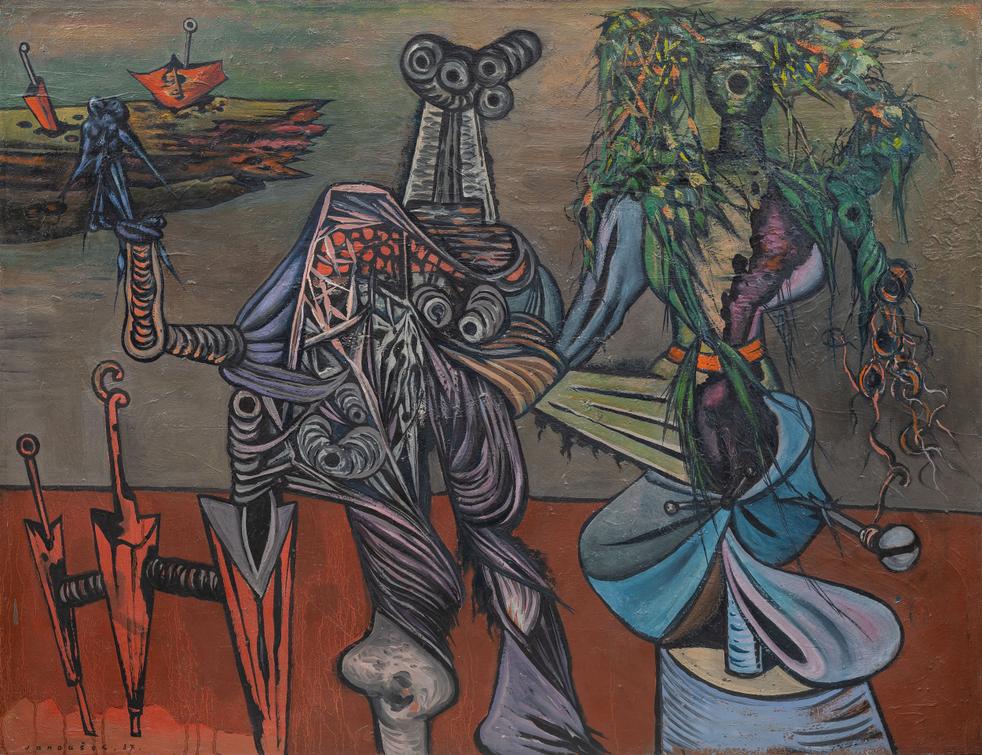
Umbrella Maker’s Wedding
Estimate: 2,000,000 CZK – 3,000,000 CZK
Starting price: 1,500,000 CZK
1,500,000 CZK


František Janoušek was one of the most prominent figures in Czech imaginative painting of the 1930s. His work approached Surrealism, while developing along distinctly individual lines. From the middle of the decade onwards, his painterly expression became freer, colour acquired a more autonomous effect, and a sense of unease and tension grew increasingly pronounced in his paintings. Umbrella Maker’s Wedding is one of the outstanding works of this period. Its inspirational source was the famous passage from Part VI of the Songs of Maldoror by the Comte de Lautréamont: ‘Beautiful […] as the chance encounter of a sewing machine and an umbrella on a dissecting table!’ This metaphor, one of the defining sources of inspiration for Surrealism, found distinctive expression in Janoušek’s painting through the unexpected interconnection of organic and mechanical forms.
The painting is characterised by a bold, free brushwork and a rich range of tonal gradations. The two central hybrid beings, composed of anatomical, botanical and mechanical elements, represent a newly married couple, as the title suggests. The sinewy figure on the left carries several umbrellas, one of which penetrates the body of the figure on the right, conceived in vegetal terms, which accepts this intrusion with astonishing indifference. Here, Janoušek dissolved the boundaries between human beings, nature and the world of objects, creating a dreamlike reality subject to constant transformation. The wedding motif becomes a grotesque ritual involving two elusive beings, while objects lose their ordinary functions and become part of a fantastical narrative. The austere, almost stage-like setting and subdued palette heighten the sense of alienation and uncertainty. Umbrella Maker’s Wedding thus offers a compelling illustration of the shift in Janoušek’s work during the second half of the 1930s, when playfulness and grotesque exaggeration became increasingly permeated by motifs of disintegration, menace and existential anxiety.
The work has been exhibited and reproduced on numerous occasions and comes directly from the artist’s family. The painting is recorded in the family’s card-index catalogue under No. 256/112 and will be included in the catalogue raisonné being prepared for a forthcoming monograph by Mgr. E. Vele. It was assessed during consultations with Prof. J. Zemina and Mgr. E. Vele. An expert opinion by PhDr. K. Srp is attached.
Reproduced in:
· Listy, Čtvrtletník pro umění a filosofii, vol. 1, No. 1, 1946, p. 74
· J. Chalupecký: František Janoušek 1890–1943, Malířské dílo, Nelahozeves, 1965, fig. 98
· J. Kohoutek: František Janoušek, Obrazy z let 1932–1942, Prague, 1990, unpaginated
· J. Chalupecký: František Janoušek, Prague, 1991, p. 171, fig. 112
Exhibited:
· Dnešní Mánes, III. výstava, Oslavy 50 let Mánesa, SVU Mánes, Prague, 12 October – 28 November 1937, cat. No. 89
· František Janoušek, Posmrtná výstava malířského díla, SVU Mánes, Prague, December 1947, cat. No. 68
· Imaginativní malířství 1930–1950, Aleš South Bohemian Gallery, Hluboká nad Vltavou, March–April 1964, cat. No. 22
· František Janoušek 1890–1943, Malířské dílo, Central Bohemian Gallery, Nelahozeves Castle, 21 August – 31 October 1965, cat. No. 98
· František Janoušek, Malířské dílo, SVU Mánes, Prague, January 1966, cat. No. 33
· František Janoušek, Obrazy a kresby 1929–1942, Brno House of Arts, 21 May – 30 June 1985, cat. no. 61
· František Janoušek, Obrazy z let 1932–1942 (exhibition marking the centenary of the artist’s birth), Central Cultural House of Railway Workers, Prague, 13 September – 7 October 1990, cat. No. 14
· František Janoušek 1890–1943, Obrazy a kresby, SVU Mánes, Prague, 19 November 1991 – 1 January 1992, cat. No. 79
Other lots in the same auction:
 Cookies settings
We use cookies to improve your user experience and our services. You can give your consent by clicking on the button "Allow all".
More information about data protection and cookies.