Lot #2
Filip Černý
The Swan
Estimate: 80,000 CZK – 130,000 CZK
65,000 CZK

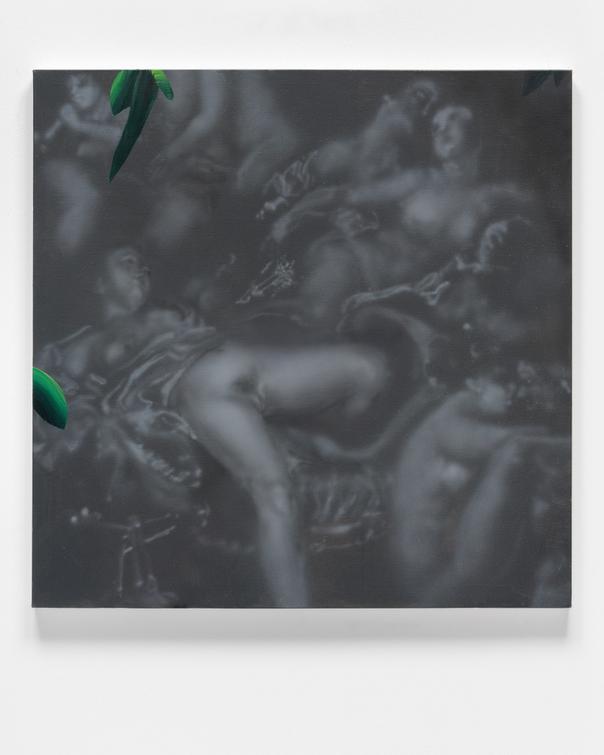
Although Filip Černý’s paintings often make full use of illusionistic techniques, his works do not merely imitate visible reality. Rather, they open up an alternative imaginative space in which ordinary perception becomes uncertain and disputed. The artist often works with contrasts between sharp contours and blurred shapes, drawing on the principles that underlie human vision: the delay that the eye needs in order to focus as well as the impossibility of taking in an entire image at once. From a technical perspective, he makes use of the contrasts between classical painting, airbrushing, and stencils, which help him construct an ambiguous space permeated by optical illusions, distorted perspectives, and visual elements reminiscent of digital imagery. His work brings together abstraction, figural themes, interiors, landscapes, and references to iconic works from art history. The painting Labuť (The Swan) is based on the ancient mythological motif of Leda and the swan, which has been a favorite theme in European art since the Renaissance. It depicts the god Zeus, who, in the form of a swan, seduces the Spartan queen Leda. The subject was often heavily eroticized, particularly during the rococo period, to the extent that it could border on a pornographic scene. Černý’s painting is a reference to just such a work by the painter François Boucher. The artist took the central motif from the historical original, rendered it in monochrome, and complemented it with surrounding figures. The scene is depicted with the characteristic optical ambiguity: The painting appears to go slightly out of focus before the viewer’s eyes. A subtle hint is provided by the green leaves with sharp contours at the edge of the canvas. They suggest that the eye is focused on a sort of secondary scene outside the actual space of the painting, while the scene itself remains but a blurred background.
70 % of the hammer prize is allocated to support the non-profit foundation Spolu s odvahou, a member of the Bátor Tábor Family.
Other lots in the same auction:

 Cookies settings
We use cookies to improve your user experience and our services. You can give your consent by clicking on the button "Allow all".
More information about data protection and cookies.