Lot #185
Emil Filla (1882–1953)
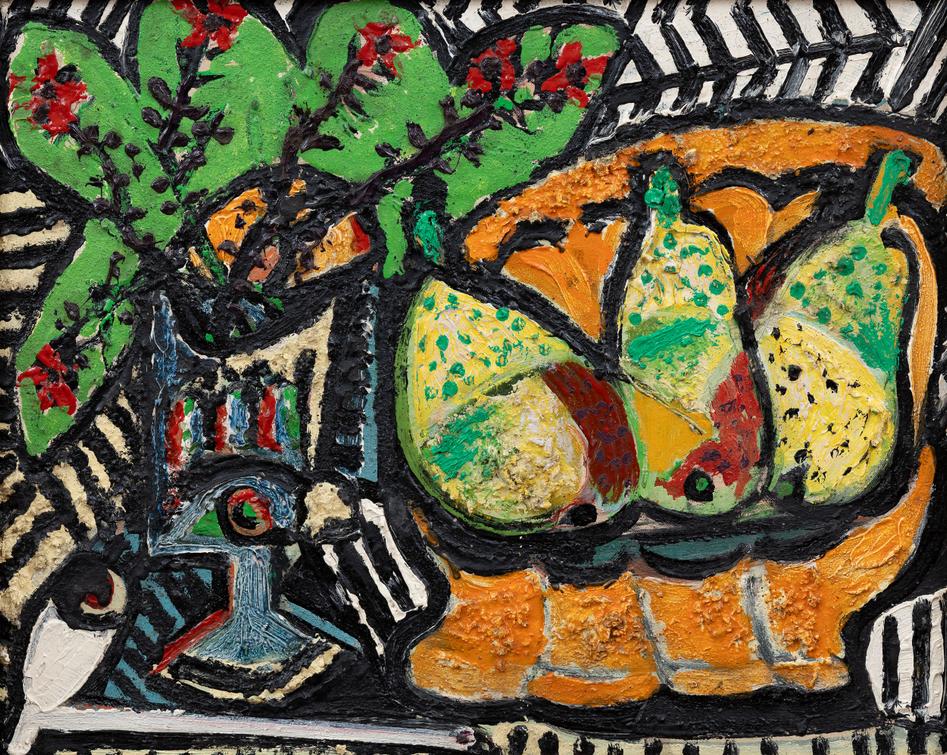
Still Life with Pears
Estimate: 1,500,000 CZK – 2,500,000 CZK
Starting price: 1,200,000 CZK
2,100,000 CZK

This painting from 1947 represents a typical post-war still life by Emil Filla, combining his lifelong interest in the Cubist construction of the picture with a newly developed and highly original approach characterised by distinctive impasto and intense colours. The work was created shortly after the artist’s return from the Buchenwald concentration camp, where he had been imprisoned between 1939 and 1945. In the post-war period, once he had regained his physical strength, he resumed painting with renewed intensity, and still lifes became one of the themes to which he repeatedly returned. In these works, his pre-war Cubist experience intertwines with a new expressive use of colour and a strong sense of materiality in the paint itself.
The presented still life contains all the essential features of this new approach. The composition is centred on a motif of fruit and flowers, complemented by a delicate, stylised pipe in the lower left corner. The scene is dominated by three pears placed in a basket at the centre of the composition. They are modelled in broad planes of yellow, green and red tones, with their volume emphasised by a striking black contour that also structures the entire pictorial space. The basket is stylised into an arch, its rim creating a strong compositional frame for the central motif. The left side of the composition is complemented by a goblet containing sprigs of small flowers. The flowers are rendered in fresh green and red accents, and their apparent trembling movement forms a counterbalance to the substantial forms of the motionless fruit. Behind the objects unfolds a background rhythmically shaped by strong black lines, defining the individual colour fields while simultaneously unifying the firmly constructed pictorial structure.
A period photograph documenting the painting directly in Filla’s studio has survived in connection with this work. The authenticity of the painting has been verified by the Filla Foundation, and it will be included in the forthcoming catalogue raisonné. During consultations, the work was assessed by Professor J. Zemina and PhDr. K. Srp. An expert opinion of Mgr. T. Mátl Donné is attached.
Other lots in the same auction:

 Cookies settings
We use cookies to improve your user experience and our services. You can give your consent by clicking on the button "Allow all".
More information about data protection and cookies.