Lot #152
Emil Filla (1882–1953)
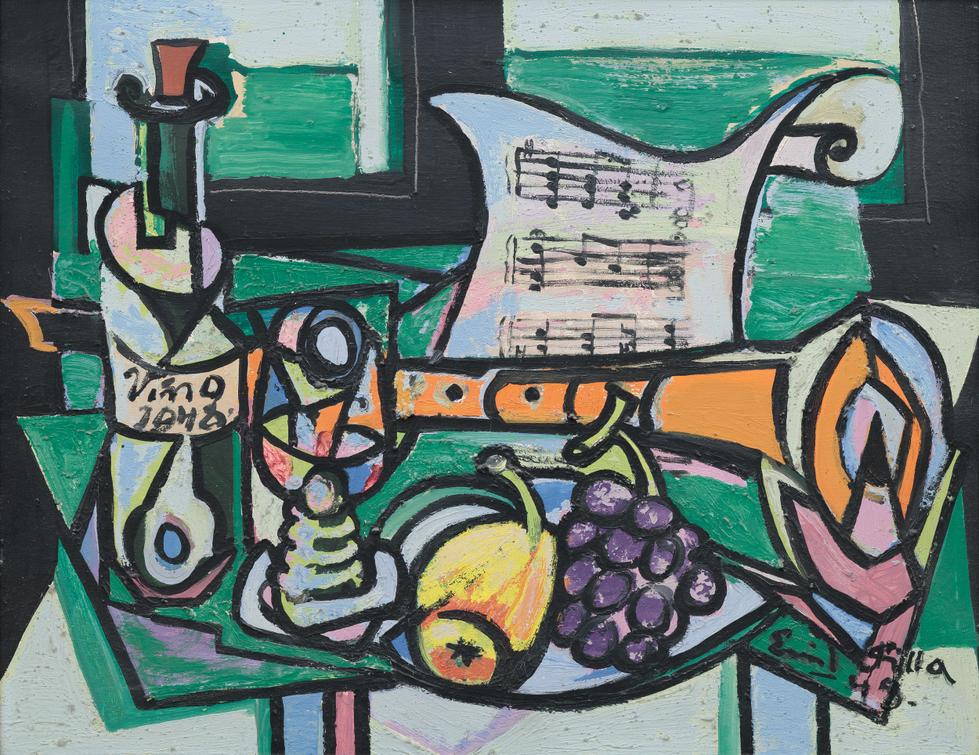
Musical Still Life
Estimate: 3,000,000 CZK – 6,000,000 CZK
Starting price: 2,200,000 CZK
4,000,000 CZK

In his post-war work, Emil Filla returned to several of the principal thematic areas that had long occupied his artistic practice. Alongside cycles of Expressionist heads, genre-based figurative motifs and allegorical scenes, he also created sensuously conceived still lifes, which represent one of the high points of his late painterly expression. During this period, a vivid and intense use of colour re-emerged in his work, recalling his artistic experience of the mid-1930s, when he had come under the influence of Surrealism.
After the Second World War, Filla found a suitable environment for concentrated work at the château in Peruc, where, through the intervention of the poet Vítězslav Nezval, he was able to rent an entire wing from the Ministry of Agriculture. At the same time, his thoughts repeatedly returned to his experiences of seventeenth-century Dutch genre painting, echoes of which can be found in the still lifes of this period, for example, in the inclusion of Baroque glassware and traditional table objects. Musical Still Life from 1948 represents a characteristic example of this phase in Filla’s work, synthesising the legacy of Cubism with a more relaxed brushwork and expressive colours.
Arranged upon a table are a series of objects presented to the beholder – a roll of sheet music, a wine bottle bearing the self-explanatory inscription “Wine 1948”, a plate with grapes and an apple, a goblet and a clarinet – all reduced to geometrical volumes that create a dynamic and rhythmically structured arrangement of forms. A strong black outline defines the individual areas of colour and emphasises the composition's construction principle. The colour palette is vibrant and highly contrasting: shades of green predominate, complemented by accents of orange, violet and pale blue, which enliven the pictorial surface while creating a harmonious whole.
The combination of a musical motif with the traditional still-life theme belonged among Filla’s preferred subjects, as it allowed him to connect the rhythm of music with the rhythm of painterly composition. The work comes across not merely as an arrangement of objects but also as a visual analogue to musical structure.
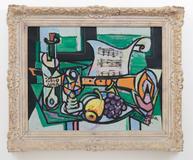
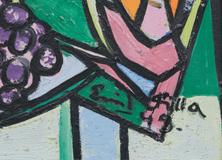
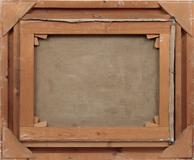
On the stretcher appears Filla’s inscription “125/48”, indicating the work’s serial number and the year in which it was painted. The painting retains its original artist-designed framing. Its authenticity has been verified by the Filla Foundation, and it will be included in the forthcoming catalogue raisonné. During consultations, the work was assessed by Prof. J. Zemina and PhDr. K. Srp. An expert opinion of Mgr. T. Mátl Donné is attached.
Other lots in the same auction:

 Cookies settings
We use cookies to improve your user experience and our services. You can give your consent by clicking on the button "Allow all".
More information about data protection and cookies.