Lot #102


Václav Špála (1885–1946)
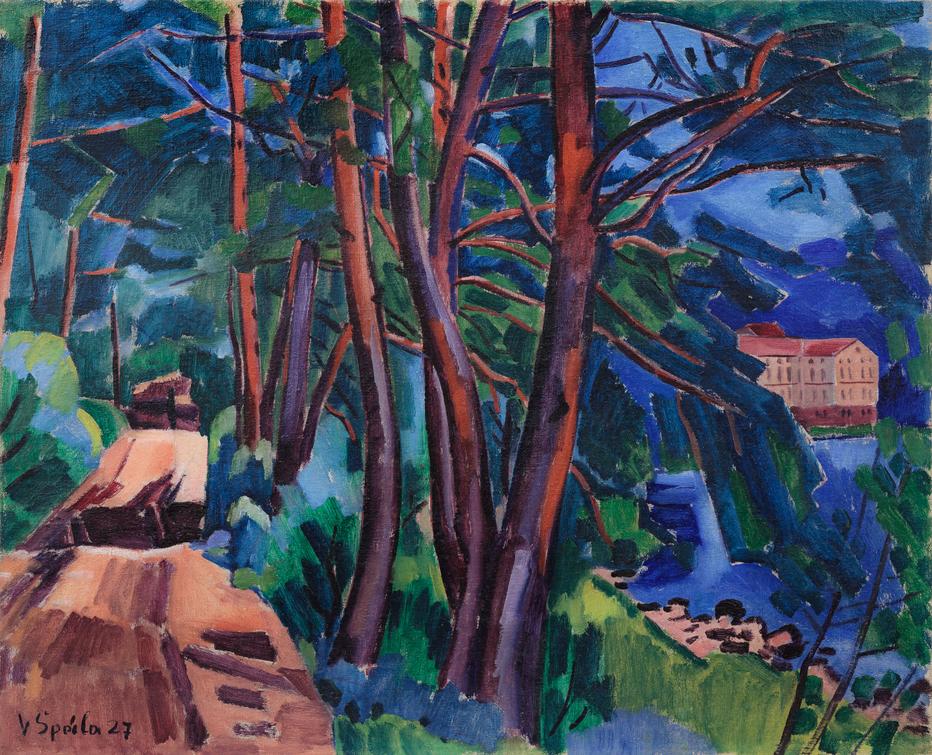
On the Vltava River
Estimate: 6,000,000 CZK – 12,000,000 CZK
Starting price: 4,000,000 CZK
6,600,000 CZK

The presented painting originates from the second half of the 1920s, a key period in Václav Špála’s work, when he repeatedly returned to South Bohemia, particularly the regions around Písek and the settlement around the Zvíkov castle, shaped by the confluence of the Vltava and Otava Rivers. Here, amidst the dramatically contoured river valleys, he discovered one of the most powerful sources of inspiration for his mature landscape painting.
On the Vltava River belongs to the beginnings of the so-called Blue Period, regarded as the pinnacle of Špála’s artistic career. The composition is structured around the contrast between the vertically rhythmical pine trunks in the foreground and the calmer horizontal water surface in the background. On the left, a forest path opens between the trees, accompanied by a small building that does not function narratively but rather serves as a quiet, almost inconspicuous element embedded within the dynamic natural setting. On the right-hand side, the trees part to reveal a view of the river and the ochre façade of Weil’s Mill on the opposite bank, standing in contrast to the dark landscape.
The colour palette centres on a broad spectrum of blue tones – from deep, almost nocturnal hues to lighter, vibrating shades, which the artist combined with accents of warm reds and beiges. In this canvas, Špála fully developed his conviction that colour should function as an autonomous and expressive element of painting. At the same time, the motif of the deep riverbed, bordered by steep banks and dense vegetation, reflects his enduring preference for landscapes charged with inner tension and the elemental energy of nature.
The formal treatment reveals the influence of Cubism as well as a Cézanne-like structural approach to composition. At the same time, however, freer and more expressive brushwork is evident, in which the artist moved away from strict analytical methods towards a more synthetic and personal mode of expression. The work thus represents an exceptionally fine example of Špála’s mature landscape painting, synthesising the lessons of Cubism, Fauvism and his own distinctive chromatic imagination. It stands out not only for its painterly excellence but also for the strength of expression that makes it a compelling portrayal of living, pulsating nature.
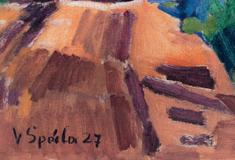
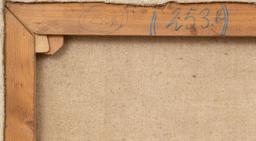
On the stretcher appears the artist’s inscription “253b” in double brackets. The work is listed in the artist’s catalogue raisonné (E. Burget / R. Musil: Václav Špála, Catalogue Raisonné /1885–1946/, Prague, 2002, p. 54, Road and Pines before the Bridge) and can be seen in the attached photograph of the painter in his studio in 1930. Its first owner was the collector Rudolf Hršel from Hradec Králové. The painting was examined in consultation with Prof. Jaromír Zemina and PhDr. Karel Srp. An expert opinion of Mgr. K. Guth-Vladaj, PhD, is attached.
Other lots in the same auction:

 Cookies settings
We use cookies to improve your user experience and our services. You can give your consent by clicking on the button "Allow all".
More information about data protection and cookies.