Lot #97
Josef Čapek (1887–1945)
Drinker
Estimate: 14,000,000 CZK – 22,000,000 CZK
Starting price: 9,000,000 CZK
28,400,000 CZK

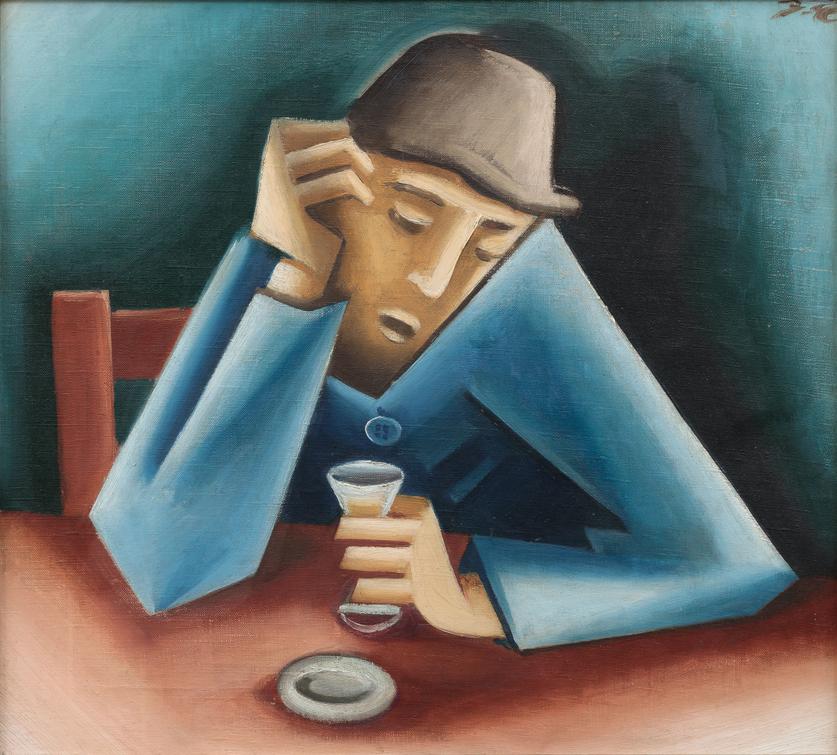
The motif of a drinker was one that Josef Čapek deliberately chose for its apparent inconspicuousness and banality: a man in a hat at a table, a glass of wine, a gesture of inward withdrawal. It was precisely such an “ordinary type” – as the artist himself aptly described his drinker as early as 1913 – that presented him with the challenge of getting beneath the surface of everydayness and extracting from it something akin to a revelation, transcending mere documentation of a social condition. This ambition did not diminish in the works created after the First World War, to which the present painting belongs; rather, it acquired a new visual persuasiveness.
At the time this canvas was produced, Čapek painted in quick succession several other variations on the theme (Drinker with a Pipe, Drinker at the Window, and Drinker with a Cigar), each seeking a different resolution of the relationship between figure and space and a distinct expressive effect. While those three works employ predominantly muted, ochre-grey tonalities referring to analytical Cubism, this canvas differs markedly: a dominant deep blue, in conjunction with turquoise and pink tones, creates a chromatic harmony that at the time was only just heralding the future colouristic freedom of Čapek’s work. The illumination of the colour planes and the painting’s meditative radiance thus do not stand in opposition to the expressive angularity of the forms, but rather are united with it.
The formal language of the painting is characteristic of Čapek’s Cubism (or Cubo-Expressionism) at the turn of the 1910s and 1920s: the figure is broken down into a system of sharply angular planes, the man’s body becoming almost an architectural structure bending over the table. The hands – large, geometrised, enclosing the space before the drinker – form the compositional centre of gravity. The glass, present as a symbolic element in other drinker paintings as well, is not a realistic detail but an object-symbol around which the figure’s quiet, motionless existential presence is concentrated. The psychological state of the figure is conveyed here exclusively through formal and chromatic condensation, without any narrative incentive.
The painting was exhibited at the renowned Second Exhibition of Tvrdošíjní [The Obstinate Ones] in January 1920 at the Weinert Hall in Prague, where Čapek presented a total of thirty-eight works, predominantly with social themes. The exhibition attracted exceptional critical attention: Václav Nebeský pointed to the distinctiveness of Čapek’s approach and his ability to lead his subjects towards a “purely artistic re-poetisation of immediate reality”, while Stanislav Kostka Neumann observed in Čapek’s finest works of the period a fusion of expression, construction, and mood in balanced proportion. The Drinker fully corresponds to this description.
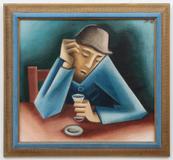
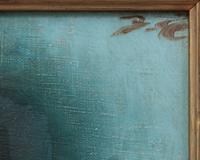
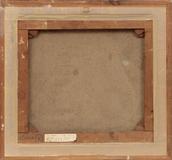
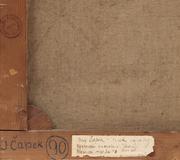
The first owner of the work was the distinguished art collector JUDr. František Čeřovský. A label on the reverse referring to its publication in the journal Musaion (Journal for Modern Art, spring 1920, vol. I, p. 78) is incorrect and in fact relates to the work Drinker with a Cigar. Original artist’s mounting. Assessed in consultation with Prof. J. Zemina and PhDr. R. Michalová, PhD. An expert opinion of PhDr. P. Pečinková, CSc., is attached.
Published:
· P. Pečinková: Pracoval jsem mnoho, Soupis výtvarného díla Josefa Čapka [I Worked a Lot: Catalogue Raisonné of the Visual Work of Josef Čapek], Part Three: Painting, Osmička Endowment Fund, Humpolec 2023, p. 523, cat. No. III/136
Solo exhibitions:
· Comprehensive Exhibition of the Painter Josef Čapek, KVU Aleš, Brno 1924, cat. No. 43
· 6th Exhibition of Tvrdošíjní [The Obstinate Ones]: A Selection of Works by Josef Čapek, Krasoumná jednota, Prague 1924, cat. No. 59 or 60
· The Work of Josef Čapek, September–October 1960, House of Arts Brno, cat. No. 73
Group exhibitions:
· 2nd Exhibition of Tvrdošíjní, 6–31 January 1920, Weinert Art and Auction Hall, Prague; three entries listed under the title Drinker: cat. Nos. 80, 81, 82 – the present work was one of them
· Revelation – Existence – Truth: Figurative Motifs in the Work of J. Čapek 1913–22, 26 June – 7 September 1997, Czech Museum of Fine Arts, cat. No. 61a
Other lots in the same auction:

 Cookies settings
We use cookies to improve your user experience and our services. You can give your consent by clicking on the button "Allow all".
More information about data protection and cookies.