Lot #82
Josef Šíma (1891–1971)
Field in Brie
Estimate: 5,000,000 CZK – 10,000,000 CZK
Starting price: 4,000,000 CZK
4,500,000 CZK

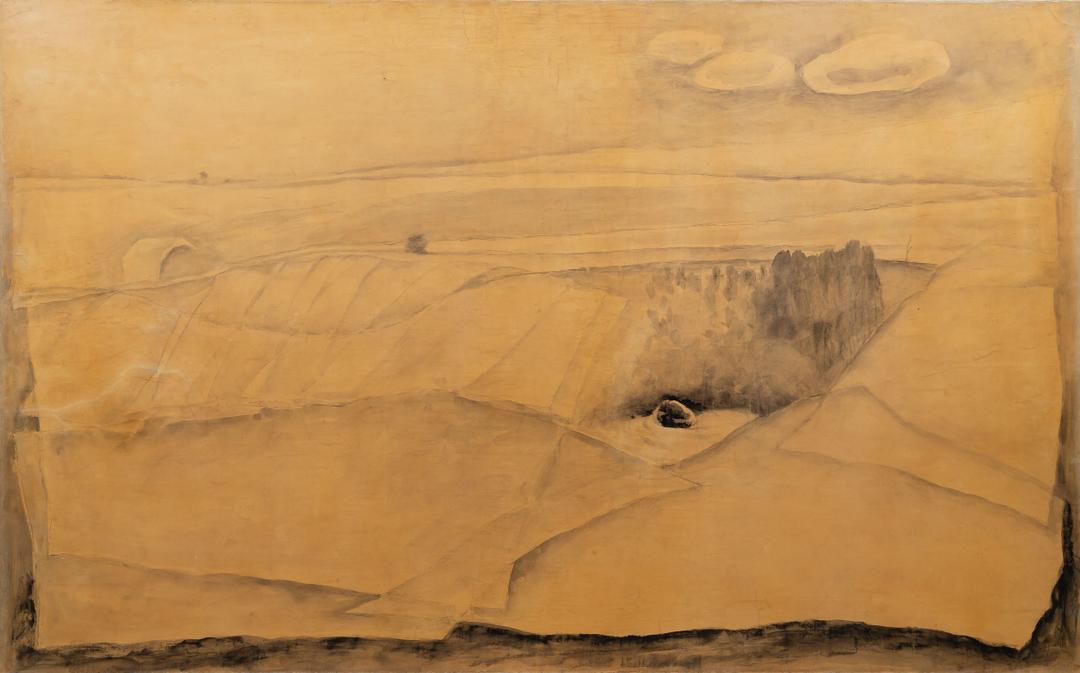
This large-scale work on paper was created after Šíma’s prolonged creative hiatus, during an exceptionally fertile period that stands at the intersection of two distinct expressive modes in his oeuvre. One reflects the fading theme of the Brie landscapes; the other, a slightly darker cycle of Orpheus’s Gate. The former continues the thematic explorations of his earlier Le Grand Jeu period, while the latter heralds a renewed creative energy capable of competing with the most current trends in the French and American abstract painting. It was the paintings of the mid-1950s that signalled Šíma’s rediscovered interest in the poetics of Le Grand Jeu and in the verses of Gilbert Lecomte, whose publication in Gallimard’s Testament series in 1955 became a crucial creative stimulus for the artist. The present landscape, created in 1954, thus captures a transition from the meditative clarity of luminous plains to the darker, more materially weighty earth of Šíma’s later work.
With its generous format, the work opens up the landscape in an almost panoramic manner. This quality was aptly described by Henri Michaux, who in 1960 referred to Šíma’s floating fragments of earth as “a tissue flooding everything, omnipresent in fibres and layers, a substance of fine furrows absorbing light.” Šíma did not depict the landscape so much as record the movement of light through it. Here he worked with layers of translucent paint, through which the warm ochre tonality of the ground shows, whilst charcoal rhythmically traces geological fractures and horizontal gradations of terrain. The composition develops his characteristic motif of land reduced to a system of rectangular forms: undulating fields, islands of vegetation, and clouds –substantial yet weightless – drifting across the upper third of the surface.
The dark boulder set at the centre of the composition is not merely a landscape element. Within the context of Šíma’s imagination, it represents an ancient menhir, a primal mass emerging from the chaos of an unorganised world – the first tangible form on the threshold of creation. Such forms – monumental, religiously mute, and wreathed by a kind of primordial vegetation – become in Šíma’s work of the 1950s bearers of a cosmogonic myth: they embody the moment when the first archetypes begin to arise from formless matter. With its closed, almost egg-like shape, the boulder refers to a motif that served Šíma as a symbol of origin and permanence, endowing the entire landscape with the quality of a living organism rather than a passive scene.
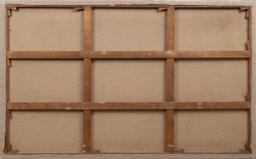
The work originally comes from a French collection and subsequently from an important Prague collection. A study for this work was presented at the exhibition Lumière: autre terre. Joseph Sima / Henri Michaux (Orbis Pictus, Paris, 18 October – 21 December 2019, cat. No. 16, reproduced in the catalogue on pp. 36–7). During conservation, it was mounted onto canvas and relined. It was assessed in consultation with PhDr. R. Michalová, PhD, and Bc. Ch. Zimová. An expert opinion of PhDr. K. Srp is attached.
Other lots in the same auction:

 Cookies settings
We use cookies to improve your user experience and our services. You can give your consent by clicking on the button "Allow all".
More information about data protection and cookies.