Lot #72
Václav Radimský (1867–1946)
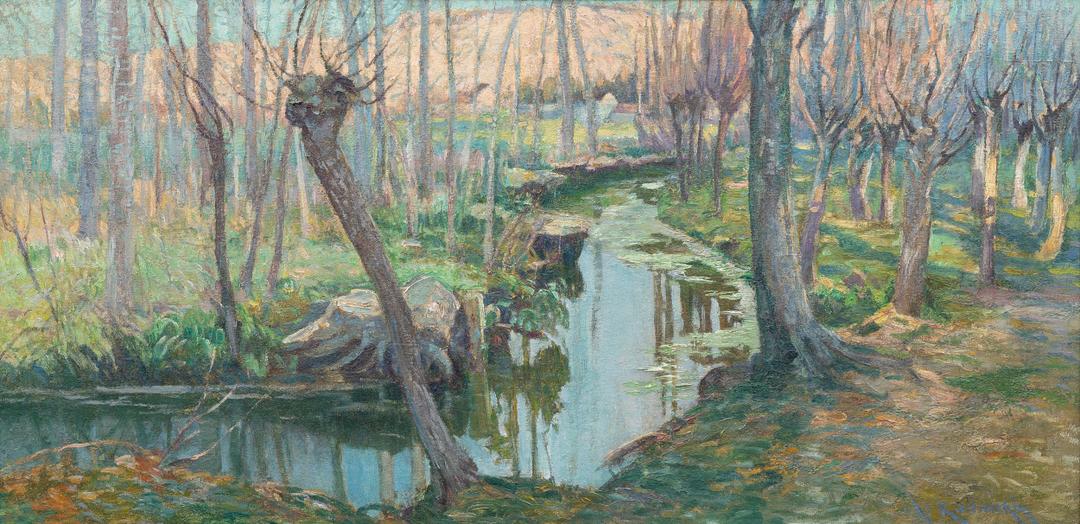
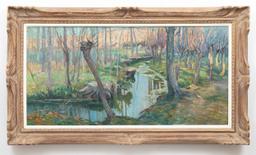
Stream near Giverny
Estimate: 1,500,000 CZK – 2,500,000 CZK
Starting price: 1,200,000 CZK
2,000,000 CZK

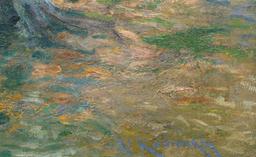
Whilst in France, Václav Radimský found a rich source of inspiration in waterways, their surroundings, and at times also in rural buildings, which together with nature form an inseparable organic whole. The painting presented here belongs to this – his most highly regarded – creative period. The tree trunks, among other elements, are rendered in a characteristic manner: they appear almost modelled with clearly defined, impasto brushstrokes, without flowing transitions. On closer inspection, the colours remain distinct, only to merge into a convincing whole when viewed from a distance. In this way, even the seemingly unnatural, synthetic violet that Radimský was fond of using aptly complements the overall visual effect.
The scene depicts an unpeopled corner of nature at the boundary between meadow and stream, framed by trees. This motif recurs in a number of the artist’s later works from both France and Bohemia. He also often softened or obscured a direct view of the horizon by means of a suitably chosen natural barrier. Here too, the horizontal line of the background is intersected by the verticals of numerous trunks and the spreading crowns of willows reaching skywards.
We encounter here a smaller variant of a work that Radimský presented shortly after its creation, first at the Paris Salon on the Champs-Élysées in 1899, and subsequently at Rudolfinum in Prague in 1901 (cat. No. 9, under the title Stream near Giverny, Normandy, Autumn Mood, offered for 1,600 crowns). This larger version (110 × 180 cm) was also published and reproduced in the cultural periodical Zlatá Praha [Golden Prague] (vol. 22, No. 19, 24 February 1905, text on p. 226, illustration on p. 217, under the title Pasture), where the author of the accompanying commentary did not conceal his enthusiasm for the colouring, which he described as “its most beautiful and most essential aspect” – a remark that would certainly apply here as well. The rather uncommon format chosen by Radimský likewise confirms the connection with the aforementioned larger variant, characterised by its pronounced landscape format. Closely comparable to the present canvas – in terms of motif, brushwork, and colour – is, for example, the representative painting Old Mill near Giverny in the collections of the National Gallery in Prague (oil on canvas, 1899, 90 × 135 cm, inv. No. O 826).
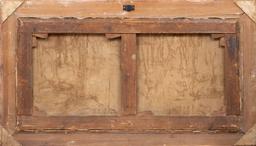
In view of its artistic quality and the contextual connections outlined above, this work undoubtedly deserves attention from both scholars and collectors. A label on the reverse of the stretcher bearing the inscription “Vernon” refers to the place where Radimský had been settled since 1895, known as La Bergamotte in Le Goulet, located near the town of Vernon. The work was assessed in consultation with Prof. J. Zemina and Mgr. M. Dospěl, PhD. An expert opinion by Mgr. P. Kubík is attached.
Other lots in the same auction:

 Cookies settings
We use cookies to improve your user experience and our services. You can give your consent by clicking on the button "Allow all".
More information about data protection and cookies.