Lot #32
Theodor Pištěk (1932–2025)
Self-Portrait at the Window 1
Estimate: 10,000,000 CZK – 20,000,000 CZK
Starting price: 8,000,000 CZK
13,000,000 CZK

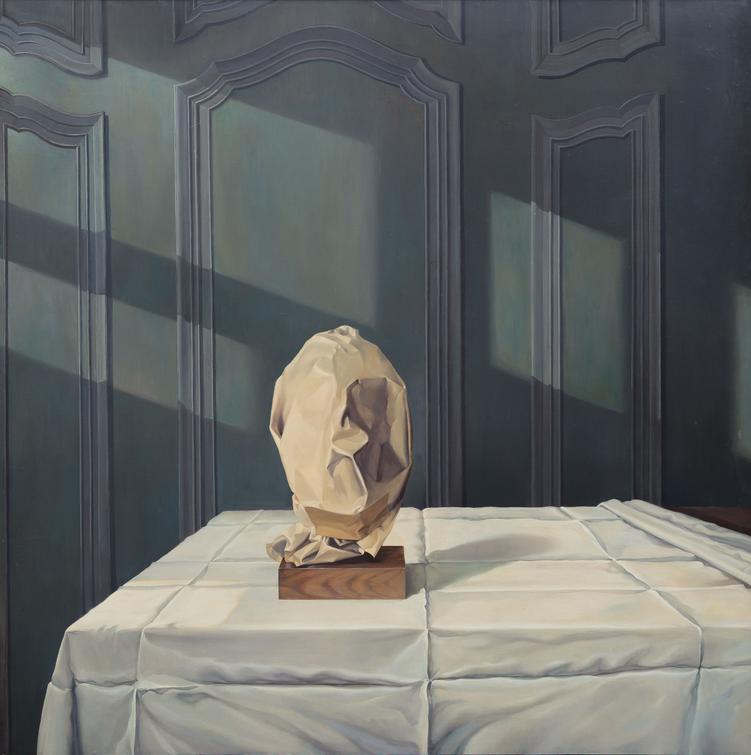
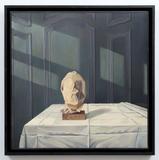
Self-Portrait at the Window 1 occupies a distinctive position within Pištěk’s realist oeuvre. It was created during a period when the artist repeatedly returned to the motif of the veiled human figure as an image of both personal and social unfreedom. A head wrapped in crumpled paper, set upon a wooden plinth and placed on a table covered with wrapping paper, recalls an antique bust set aside in storage – a silenced object deprived of its face. The background consists of the wall of an opulent, ornamented interior, across which bands of daylight from a window are cast. The contrast between the silent immobility of the veiled head and the lively, warm, shifting light lends the composition its unsettling ambiguity.
Pištěk builds upon a theme he was simultaneously developing in works such as Family Portrait (1976) and Nude Maja (1980), where fingers protruding from the wrappings reveal that a living body, not a sculpture, lies beneath the covering. In the present painting (as in its counterpart Self-Portrait at the Window 2), however, any such indication is absent. The wrapping is absolute; the artist’s identity dissolves into an indeterminate form. From a technical standpoint, the painting is grounded in an illusionistic manner akin to the tradition of trompe-l’œil, which Pištěk brought to remarkable convincingness: the folds of paper, the grain of the wood, and the subtle shadows on the canvas appear almost tangible, yet serve to depict something fundamentally concealed. The artist later rejected any association of his work with so-called photorealism or hyperrealism, describing his approach instead as a new Romanticism – a striving not merely to imitate what is seen, but to evoke atmosphere and suggest a narrative whose very occurrence begins to seem uncertain. From an aesthetic perspective, comparisons may be drawn with the conceptual artist duo Christo and Jeanne-Claude, renowned for wrapping entire monuments and architectural structures in fabric. Pištěk’s act of veiling, however, is inward and introspective: he wraps himself rather than the surrounding world. In this way, the painting acquires a dimension characteristic of hyperrealism produced behind the Iron Curtain, where an ostensibly impersonal depiction of surfaces often served as a means of reading between the lines.
The work was first publicly presented a year after its creation at the artist’s exhibition at the Václav Špála Gallery (1982), where it also served as the motif for the exhibition poster. Since then, it has appeared in a number of major displays of Czech painting from the second half of the twentieth century. At the exhibition Senzační realismus [Sensational Realism] at the Aleš South Bohemian Gallery (2022), both Self-Portraits at the Window, together with the painting Family, were chosen as the conceptual culmination of the entire display and, for the first time, shown alongside works by Richard Estes, Gerhard Richter, and Jacques Monory, thus placing Pištěk’s work within the broader context of international realism, where it stands as a distinctive and fully equal voice. The work comes from an important and high-quality Prague collection and has been repeatedly reproduced and exhibited. It was assessed in consultation with PhDr. K. Srp and Mgr. M. Dostál. An expert opinion of PhDr. J. Machalický is attached.
Published:
I. Neumann / J. Kříž et al.: Theodor Pištěk, Prague 2007, reproduced on the cover and on pp. 122–3
Exhibited:
Theodor Pištěk: Paintings, Drawings, Film, Václav Špála Gallery, Prague, 2 September – 3 October 1982, cat. No. 11, reproduced on the exhibition poster and in the catalogue.
Theodor Pištěk, Aleš South Bohemian Gallery, Hluboká nad Vltavou, 3 September 1993 – 31 January 1994, no cat. No., reproduced in the catalogue.
Art when Time Stood Still: The Czech Art Scene 1969–1985 (The House at the Black Madonna, Prague, 3 October – 24 November 1996; Moravian Gallery in Brno, 31 January – 23 March 1997; Gallery of Fine Arts in Cheb, 10 April – 31 May 1997), no cat. No., reproduced in the catalogue.
Theodor Pištěk: Paintings, Václav Chad Gallery, Zlín, 19 May – 18 August 2017, no cat. No., reproduced on the reverse of the exhibition catalogue.
Theodor Pištěk: Angelus, Brno House of Arts, 24 September 2019 – 12 January 2020, no cat. No., reproduced in the catalogue, p. 88.
Theodor Pištěk: Sensational Realism, Aleš South Bohemian Gallery, Hluboká nad Vltavou, 26 June – 30 October 2022, no cat. No., reproduced in the catalogue, pp. 95–96.
Other lots in the same auction:

 Cookies settings
We use cookies to improve your user experience and our services. You can give your consent by clicking on the button "Allow all".
More information about data protection and cookies.