Lot #27
Václav Radimský (1867–1946)
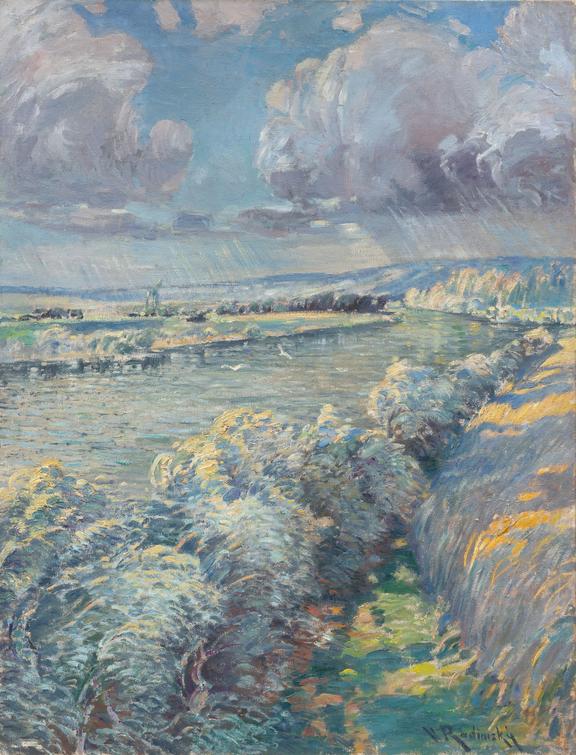
Rain
Estimate: 1,500,000 CZK – 2,500,000 CZK
Starting price: 1,200,000 CZK
1,900,000 CZK

This presented painting of refined colour and composition, rare in its portrait format, comes from Václav Radimský’s highly valued artistic period around 1905. It is rendered in a distinctive style of perhaps the most renowned Czech Impressionist, whose international reputation was further enhanced by his stay in the French town of Giverny, where he often painted side by side in friendly harmony with Claude Monet himself.
Rain demonstrates the artist’s tireless diligence: through the demanding Impressionist technique of individual, divided brushstrokes, he masterfully captured the quivering vitality and movement of the landscape, as well as the authentic atmosphere of the day. In its execution and chosen painterly manner – making use of thick, impasto layers of paint – he once again transcended academic conventions, building upon the legacy of the Barbizon masters and presenting a landscape grounded in direct observation in the open air and personal experience. Two compositional axes intersect in the work: the horizontal line of the horizon and a diagonal formed by the river’s course. The combination of these axes introduces dynamism and a necessary sense of depth into the landscape. The selected, painterly fresh fragment of scenery stands as a telling testament to the artist’s creative nature, revealing clear inspiration drawn from leading Impressionists. Informed by these models, Radimský also paid careful attention to faithfully rendering the atmospheric conditions, which in this particular case form the central raison d’être of the painting. He set himself a demanding task in depicting the ever-changing, ephemeral drama of an approaching or receding storm, which drenches the horizon in sheets of rain while sharp sidelight in the foreground illuminates the riverbank. Another striking element is the treatment of the clouds, whose expressive stylisation recalls the elemental force of the canvases of William Turner. In its charm and quality, the presented painting stands comparison with the finest examples of European art. It was assessed in consultation with Prof. J. Zemina and Mgr. M. Dospěl, Ph.D. An expert opinion of Mgr. P. Kubík is attached.
Other lots in the same auction:

 Cookies settings
We use cookies to improve your user experience and our services. You can give your consent by clicking on the button "Allow all".
More information about data protection and cookies.